What is the Lean Startup Methodology? A Complete Guide for Founders (2026)
What is the Lean Startup Methodology? A Complete Guide for Founders (2026)
Most startups fail not because they could not build but because they built the wrong thing.
They spent months sometimes years perfecting a product nobody asked for. By the time they launched, the market had moved, the money was gone, and the team was exhausted.
The Lean Startup methodology exists to prevent exactly this.
This guide explains what it is, how it works, and how you can apply it to your startup right now.
What Is the Lean Startup Methodology?
The Lean Startup is a framework for building businesses and products developed by Eric Ries and introduced in his 2011 book of the same name.
The core idea is simple:
Stop trying to build the perfect product. Start learning as fast as possible whether anyone wants what you are building.
Instead of spending months planning and building in secret you test your assumptions quickly, measure what actually happens, and use that data to decide whether to continue, change direction, or stop entirely.
It borrowed principles from lean manufacturing eliminating waste and applied them to startups. The waste it targets is building things nobody wants.
The Build Measure Learn Loop
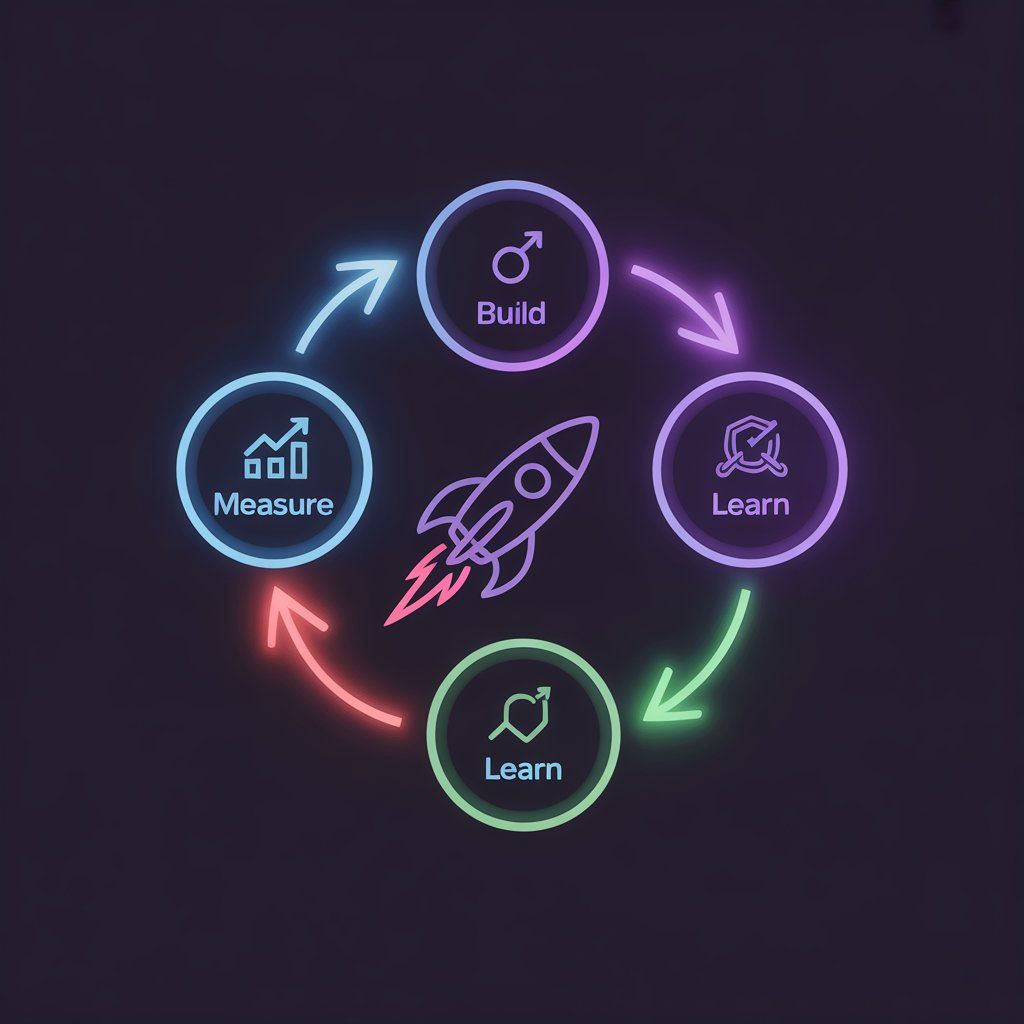
The heart of the Lean Startup is a three-step cycle called the Build Measure Learn loop.
Build:
Create the smallest possible version of your product that lets you test your most important assumption. This is called a Minimum Viable Product or MVP.
The MVP is not a half-finished product. It is a deliberately minimal product designed to answer one specific question as fast as possible.
Measure:
Put your MVP in front of real users and collect data. Not opinions data.
What are people actually doing with your product? Are they coming back? Are they paying? Are they referring others?
Learn:
Analyze the data and draw honest conclusions.
Was your assumption right or wrong? Should you continue on this path called persevering? Or should you change direction called pivoting?
Then start the loop again. Build the next thing. Measure. Learn.
The goal is to complete this loop as fast as possible because every loop brings you closer to a product people actually want.
What Is a Minimum Viable Product (MVP)?
The MVP is one of the most misunderstood concepts in startup culture.
An MVP is not:
- A buggy, broken version of your full product
- Something you are embarrassed to show people
- A prototype with no real functionality
An MVP is:
- The smallest thing you can build to test your core assumption
- Something real users can actually use and respond to
- Designed to generate learning, not impress people
Famous MVP Examples
Dropbox: Before building anything, Drew Houston made a simple demo video explaining what Dropbox would do. Overnight signups went from 5,000 to 75,000. The video was the MVP.
Airbnb: The founders photographed their own apartment, built a simple website, and rented it out to conference attendees. No complex platform. No payment system. Just a webpage and a PayPal link.
Zappos: To test whether people would buy shoes online, the founder photographed shoes at local stores and listed them on a basic website. When someone ordered, he bought the shoes at full price and shipped them. Zero inventory. Pure learning.
None of these MVPs were impressive products. All of them generated invaluable learning.
The Five Core Principles of the Lean Startup
1. Entrepreneurs Are Everywhere
The Lean Startup applies to anyone building under conditions of extreme uncertainty not just Silicon Valley founders. Corporate innovators, solo founders, and social entrepreneurs all benefit.
2. Entrepreneurship Is Management
A startup is not just a product it is an institution that requires a new kind of management focused on learning, not just execution.
3. Validated Learning
Progress in a startup is not measured by features shipped or code written. It is measured by validated learning real evidence that you are making progress toward a sustainable business.
4. Innovation Accounting
You need a new way to measure progress. Traditional accounting does not capture whether you are learning or wasting time. Innovation accounting tracks actionable metrics that tell you whether your business model is actually working.
5. Build Measure Learn
As discussed the fundamental activity of a startup is turning ideas into products, measuring how customers respond, and learning whether to pivot or persevere.
Pivot or Persevere The Most Important Decision
At the end of every Build-Measure-Learn loop, you face a decision.
Persevere:
Your data shows that your assumptions were right or close enough to refine. Keep going in the same direction with improvements.
Pivot:
Your data shows that a core assumption was wrong. You need to change direction not give up, but change strategy while keeping what you have learned.
Types of pivots:
- Zoom-in pivot: A feature becomes the whole product
- Zoom-out pivot: Your product becomes one feature of a bigger product
- Customer segment pivot: Same product, different customer
- Platform pivot: From app to platform or vice versa
- Business model pivot: How you make money changes
Pivoting is not failure. The companies that fail are the ones that keep persevering when the data is telling them to pivot.
Vanity Metrics vs Actionable Metrics
One of the most important lessons of the Lean Startup is the difference between vanity metrics and actionable metrics.
Vanity Metrics Numbers That Feel Good but Mean Nothing
- Total signups
- Page views
- Social media followers
- Press mentions
These numbers go up and make you feel like you are making progress. They tell you nothing about whether your business is actually working.
Actionable Metrics Numbers That Drive Decisions
- Daily active users
- Retention rate at day 7, 30, 90
- Conversion rate from free to paid
- Customer acquisition cost vs lifetime value
- Net Promoter Score
Track these. Make decisions based on these. Ignore the rest.
How to Apply Lean Startup Principles to Your Idea Right Now
Step 1: Identify Your Riskiest Assumption
Every business idea has one assumption that if wrong makes the entire idea fail. Find it.
Usually it is: "People have this problem and will pay to solve it."
Step 2: Design the Smallest Test
What is the smallest thing you can do to test that assumption? A landing page. A video. A manual service. A waitlist.
Step 3: Run the Experiment
Get it in front of real people not friends and family. Actual potential customers.
Step 4: Measure Honestly
Look at the data without bias. Did people sign up? Did they pay? Did they come back? Did they refer others?
Step 5: Decide Pivot or Persevere
If yes keep going and test the next assumption. If no figure out what was wrong and change direction.
Start Lean With a Validated Idea
The leanest possible first step is validating your idea before building anything at all.
Idea Magnify gives you instant market demand analysis, SWOT breakdown, TAM/SAM/SOM, competitor landscape, and monetization strategies so you enter your Build-Measure-Learn loop with real data instead of assumptions.
Start Lean — Validate Your Idea First →
Final Thoughts
The Lean Startup is not about building cheap products. It is about building smart.
It is about respecting the most valuable resource you have as a founder your time and not wasting it building things nobody wants.
Build less. Learn faster. Win sooner.
The leanest first step? Validate your idea before writing a single line of code. Try Idea Magnify free.